
Blackjack Strategy: Increase Your Chances of Winning
Blackjack is one of the oldest games of chance in the world. According to experts, the first version of the game was already mentioned in literature dating back to the early fifteenth century, under the name “twenty-one.” The history of blackjack is therefore immense, and just like in almost every other form of offline or online gambling in the U.S, blackjack is all about making the best possible decisions. But what is the best possible decision, exactly—and how can you, as a player, make it?
Simply put, the best possible choice in blackjack is the one that gives you the highest chance of winning in the long run—or, in other words, the decision that minimizes the casino’s edge, also known as the house advantage. However, it can get quite complicated if you try to calculate these odds in exact detail every time, since blackjack can be played with anywhere from 52 to 312 cards. This depends, among other things, on the specific variant being played, as there are now several popular versions of blackjack.
At the same time, this doesn’t mean that probability has no role to play when you sit down for an online blackjack session. On the contrary—blackjack is a game with an enormous number of possible strategies, ranging from simple basic rules to complex playing systems. On this page, we’ll explain what basic strategy for blackjack means and how you can master it easily.
Basic Strategy for Blackjack
Since the 1960s, computers have been used to simulate millions of blackjack hands. By doing this, researchers aim to find the best possible strategies for every variant of blackjack, both in the U.S and around the world. The basic strategy for blackjack is the result of these countless simulations, just like the corresponding blackjack rules that go with it.
The Importance of a Strategy Chart
Experienced blackjack players have probably heard of the basic strategy chart—and may have even used one themselves. This chart is a table that summarizes the optimal decisions for every possible hand combination in a round of blackjack. Many casinos sell or display these charts, but for convenience, we’ve included one below—along with an explanation.
For players interested in the basic blackjack strategy used in the U.S, here’s how to read the information in the tables below:
-
The left column shows your own hand.
-
The top row shows the dealer’s card.
-
The cell in the table where your hand and the dealer’s card intersect contains the best possible decision according to blackjack basic strategy.
Example: You are dealt a hand with a value of 12 (no Aces) and the dealer shows a 4. In the corresponding table (A1), you’ll see that in this case, the best move is to stand.
- Table Legend:
- 11+: Draw cards until the total is higher than 11.
- 12+: Draw cards until the total is higher than 12.
- 16+: Draw cards until the total is higher than 16.
- P: Stand (Pass)
- D: Double
- S: Split
- N: Do not split
Below, you’ll find the tables used to apply basic strategy in blackjack. We’ve created three different strategy charts, based on whether or not the hand contains an Ace:
-
Hard hand – No Ace, or Ace counted as 1.
-
Soft hand – Ace counted as 1 or 11, without exceeding 21.
-
Split chart – When considering whether or not to split your cards.
Basic Strategy for Blackjack with “Hard Hands”
A hard hand in blackjack is a hand that contains no Ace, or one where the Ace counts as only 1 point.
Example: A hand consisting of a 10 and a 7 is known as a “hard 17.”
Table A1: Basic Strategy for Blackjack with Hard Hands (without Ace)
| Dealer | ||||||||||
| Hand | 2 | 3 | 4 | 5 | 6 | 7 | 8 | 9 | 10 | A |
| 2 to 8 | 12+ | 12+ | 11+ | 11+ | 11+ | 16+ | 16+ | 16+ | 16+ | 16+ |
| 9 | D | D | D | D | D | 16+ | 16+ | 16+ | 16+ | 16+ |
| 10 | D | D | D | D | D | D | D | D | 16+ | 16+ |
| 11 | D | D | D | D | D | D | D | D | 16+ | 16+ |
| 12 | 12+ | 12+ | P | P | P | 16+ | 16+ | 16+ | 16+ | 16+ |
| 13 to 16 | P | P | P | P | P | 16+ | 16+ | 16+ | 16+ | 16+ |
| 17 to 21 | P | P | P | P | P | P | P | P | P | P |
Basic Strategy for Blackjack with “Soft Hands”
A soft hand in blackjack is a hand that contains at least one Ace that can count as either 1 or 11 points, without the total exceeding 21.
Example: A hand consisting of an Ace and a 4 is called a “soft 15” (11 points from the Ace and 4 points from the 4).
Table A2: Basic Strategy for Blackjack with Soft Hands (with Ace)
| Dealer | ||||||||||
| Hand | 2 | 3 | 4 | 5 | 6 | 7 | 8 | 9 | 10 | A |
| A,2 to A,6 | 12+ | 12+ | 11+ | 11+ | 11+ | 16+ | 16+ | 16+ | 16+ | 16+ |
| A,7 | P | P | P | P | P | P | P | 16+ | 16+ | 16+ |
| A,8 to A,9 | P | P | P | P | P | P | P | P | P | P |
Basic Strategy for Blackjack: The Best Choices for Splitting or Not Splitting
On this strategy chart, the letter “S” stands for Split and “N” stands for Do Not Split. This allows you to see at a glance what the statistically best decision is for every possible card combination. Once you’ve made that initial decision using this chart, you can then refer back to the previous two strategy charts for soft hands and hard hands to guide your next moves in the game.
Table A3: Basic Strategy and Splitting in Blackjack
| Dealer | ||||||||||
| Hand | 2 | 3 | 4 | 5 | 6 | 7 | 8 | 9 | 10 | A |
| 2,2 | N | N | S | S | S | S | N | N | N | N |
| 3,3 | N | N | S | S | S | S | N | N | N | N |
| 4,4 | N | N | N | N | N | N | N | N | N | N |
| 5,5 | N | N | N | N | N | N | N | N | N | N |
| 6,6 | S | S | S | S | S | N | N | N | N | N |
| 7,7 | S | S | S | S | S | S | N | N | N | N |
| 8,8 | S | S | S | S | S | S | S | S | N | N |
| 9,9 | S | S | S | S | S | S | S | S | N | N |
| 10,10 | N | N | N | N | N | N | N | N | N | N |
| A,A | S | S | S | S | S | S | S | S | S | N |
When should you stand, hit, or double down?
The decision to stand, take another card, or double down largely depends on the dealer’s upcard. Based on that card, you can accurately determine how likely the dealer is to “bust,” meaning to exceed 21 with their next card.
Dealerkaart |
2 |
3 |
4 |
5 |
6 |
7 |
8 |
9 |
10 |
Aas |
Kans dood |
35% |
37% |
40% |
42% |
42% |
26% |
24% |
23% |
21% |
12% |
- When to Stand?
In general, you should stand when the dealer shows a 2, 3, 4, 5, or 6, and you have 12 points or more. If the dealer shows a 7, 8, 9, 10, or Ace, you should stand when you have 17 points or more. - When to Double Down?
Usually, you should double down when the dealer shows a 2, 3, 4, 5, or 6, and you have 9 points. If you have 10 or 11 points, doubling down is recommended when the dealer’s upcard is a 2, 3, 4, 5, 6, 7, 8, or 9. - When to Hit?
As long as your total score doesn’t exceed 21, you may continue to request additional cards from the dealer.
Splitting Cards: When and Why?
As you probably know, you can split your cards in blackjack. This means you can divide the pair of cards you receive into two separate hands. By splitting, you increase both your chances of winning and your total bet. Especially when you’re dealt a pair of high-value cards, splitting can be a smart move.
Therefore, the decision to split or not is also an essential part of basic blackjack strategy. To help you make this decision for any possible card combination, we’ve created a table (A3) that works exactly like the previous two tables (A1 and A2). The “S” stands for “split,” while the “N” stands for “do not split.”
Once you decide whether to split your cards, you should then refer back to tables A1 and A2 for each new hand. This way, you can easily apply the basic blackjack strategy used in the U.S.
Basic Strategy and Insurance in Blackjack
When it comes to buying insurance in blackjack, the advice is simple: don’t do it. The dealer will offer you insurance in specific situations—typically when showing an Ace. Insurance pays out only if the dealer has blackjack and costs half of your original bet.
Since insurance is only offered when the dealer’s upcard is an Ace, it merely protects you in case the dealer’s second card is a 10, Jack, Queen, or King. If that happens, you receive three times the insurance premium. If not, you lose your insurance bet. However, the odds of winning an insurance bet are only 1 in 3.25 (16 out of 52 cards). In other words, the payout multiplier is lower than the probability of winning, making insurance a statistically bad wager.
Advanced Blackjack Techniques
Beyond the various blackjack variants and operators, your personal playing style also plays a major role. A strategy that doesn’t work for one player might be highly effective for another. Below are some advanced blackjack techniques that can help increase your chances of winning—both in offline and online blackjack in the U.S.
Card Counting: The Basics Explained
In live casinos card counting can significantly improve your odds. This method doesn’t work at online casinos in the U.S because cards are dealt by a Random Number Generator (RNG).
To count cards effectively, you need strong arithmetic skills and a good memory. The process involves keeping track of which cards are dealt and continually adding or subtracting point values. When many low cards are dealt, the count becomes negative; when many high cards are dealt, it turns positive. This information allows you to make better decisions while playing blackjack.
Managing Your Bets
Bet management, also known as bankroll management, is essentially about managing your money. This technique is crucial for maintaining a fun and sustainable gambling experience—just as in any other casino game.
Set a clear budget (bankroll) before you start playing, and stick to it throughout your session. By managing your bets wisely, you can better identify the moments when your money has the best chance of multiplying.
Using Side Bets
A side bet becomes available only after you’ve placed your main bet. The advantage of a side bet is that it usually requires a smaller stake than your main wager. However, it’s only available at online casinos in the U.S, not in physical casinos.
A side bet is simply an additional wager on the outcome of your hand. You can also try to form combinations with the dealer’s upcard. Although side bets can lead to larger payouts, they are generally not recommended because the house edge is usually much higher than on standard bets.
Common Mistakes and How to Avoid Them
Few casino games offer a higher payout rate than blackjack. Its popularity is also driven by the fact that players can influence their odds and improve their skills over time. However, blackjack can get complex, leading to common mistakes. Here are some of the most frequent ones—and tips to avoid them.
Overconfidence and Deviating from Strategy
A common cognitive bias among gamblers is the belief that past events influence future outcomes. For example, expecting the roulette wheel to land on red again after three consecutive reds, even though each spin is independent. This is known as the Gambler’s Fallacy.
In blackjack, this can happen when a player wins several hands in a row and assumes their odds are better for the next round. Winning two hands in a row gives you zero percent higher chance of winning the third. So stay disciplined and don’t deviate from your strategy.
Ignoring the Casino Rules
In addition to your own strategy, it’s vital to understand the specific rules of the casino where you’re playing. Each casino may have its own guidelines—some strictly forbid card counting, while others may tolerate it to a degree. Understanding these rules will help you make more informed decisions at the blackjack table.
Forgetting to Have Fun
Last but not least: gambling should always be fun—and that includes blackjack. When emotions start running high, it’s easy to forget that you’re playing primarily for entertainment.
If you find yourself losing that sense of enjoyment, be wise and stop playing.

Online Casino News in USA
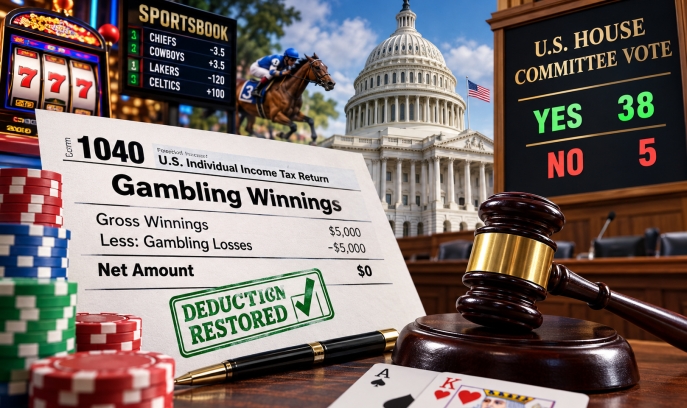
House Panel Votes to Restore Gambling Loss Deduction
October 5, 2026 — In 2025, a law was passed to charge gamblers 10% tax on gambling gross winnings with no regard for losses. This was a significant blow to the recreational gamblers who are being forced to pay taxes ...

Online Casino Gambling Fails Again in Maryland
September 19, 2026 — With Maryland voters focused on redistricting laws in the upcoming med-term elections, hopes were running high that voters might also get a chance to vote on the legalization of online casino gambli...

Skill Game Tax Proposed By Pennsylvania Lawmaker
September 7, 2026 — At a rate of 52%, gross revenue on slots, including online video slot, is already being taxed in Pennsylvania. If Pennsylvania Rep. Russ Diamond has his way, the state will soon start taxing online ...

BetRivers Casino Offers World Cup Promos & New Slots
June 25, 2026 — The FIFA World Cup has arrived in America with 32 of the world's best teams competing for the title of the best soccer team in the world. In an effort to go with a current theme, BetRivers Casino is...
Copyright 2013-2026 © LEGAL-GAMBLING-USA.COM - All rights reserved
Legal Disclaimer - Warning - Affiliate Program - Responsible Gaming - Contact
Contact

Gambling involves risk: indebtedness, dependence, isolation. Helpline: 1-800-MY-RESET (Available in the US)
Please gamble responsibly. Gambling problem? Call 1-800-GAMBLER.
Gambling is prohibited for minors.

